
.svg)


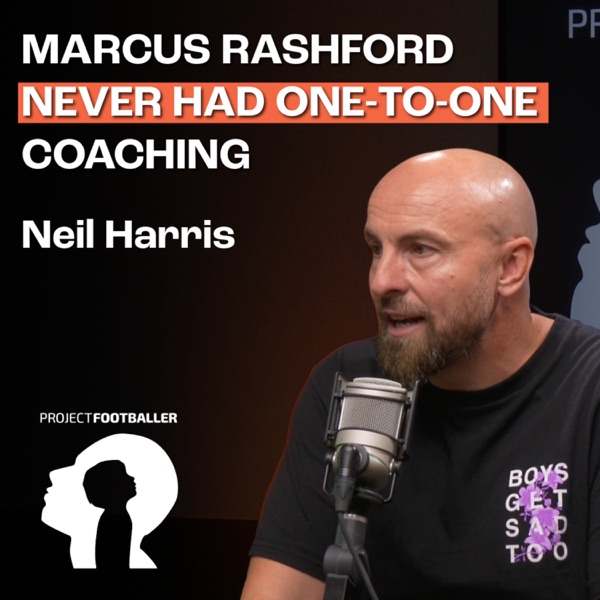
Every parent with a child in an academy, or hoping to get there, wants to know the same thing: what do coaches actually see in the ones who make it? Neil Harris has spent more than 20 years coaching in Manchester United's academy, working with players including Marcus Rashford, Kobbie Mainoo, Scott McTominay and Anthony Elanga. So when he joined us on Project Footballer, we wanted the honest version.
Talking to co-hosts Jenny and Matthew Healy, Neil kept coming back to a few simple ideas: find a player's super strength, understand the person before the player, protect their love of the game - and, for parents, stop comparing.
What separates good players from great prospects
When a new group came up to him at around under-13s, or a trialist walked through the door, Neil said the first thing he looked for was an outstanding quality - something that set a player apart, whether that was 1v1 defending, scoring goals or linking play.
The second thing is less obvious. In Neil's experience, the players who reached the highest level were very good at retaining information - seeking it out, taking it on board and acting on it. He has seen talented players for whom the coaching simply didn't click.
Asked which super strength matters most, he put technique first. In his words, "a skill is a technique done under pressure" - and decision-making is what turns that skill into good football as players move up the age groups.
Physical attributes came lower on his list. Neil worries that academy football is drifting towards favouring early developers. He is a big believer in bio-banding (grouping players by physical development rather than age alone), done properly rather than for one week a season. He was just as wary of pushing big, early-maturing players up age groups on size alone, without asking whether they're ready socially and psychologically.
"We've got to understand the person before we just look at the player."
Character counts as an outstanding quality too. Asked which players stood out for their attitude, Neil named James Garner and Brandon Williams, who he said stood out for their fearlessness, personality and genuine love of the game. You never had to ask them twice to fetch the balls, and they wanted to train, play and compete every day.
Even the best had things to work on
Neil coached Marcus Rashford for a couple of seasons at 9v9 level. For around half a season he moved him from the right wing into the right side of a back three, so he could receive from the goalkeeper with the play in front of him, carry the ball forward and combine. Some people questioned it, but the aim was long-term development and enjoying being on the ball - not results there and then.
For Neil, decisions like that only work when they're explained. "Real learning takes place once a player knows that you care about them," he said - and the same goes for parents. When a coach shows genuine interest in a child and explains why they're trying a new position or missing a tournament, parents relax, and their children relax with them.
Not being picked isn't the end either - Neil said players such as Jesse Lingard and Paul Scholes played across younger age groups for two or three years. He believes selection decisions should come with an honest conversation. In his view, releases and reports should never come as a shock if coaches have been talking to players and parents along the way.
Life inside an elite academy
Neil was clear that there is brilliant work going on in academies. But one size doesn't fit all, and he is worried about what he called premature professionalism. He described evenings timetabled from food to analysis to education to sports science before players reach the pitch, after a full day at school. In his view, it shouldn't look like a job until players are 17 and have left school. Younger players, he argued, should have two or three individual objectives tied to their own development, not match tactics.
Rest came up again and again. Neil recalled academies giving players five to six weeks off and encouraging other sports. Now he hears of shorter breaks with optional sessions that everyone attends for fear of missing out. His view was blunt: "resting is a great activity". Players need to grow, rest and simply be children.
"These are still children first and foremost, not footballers."
On positions, Neil said it is often around 13 or 14 that a player's likely position starts to become clearer, and it can settle much later. He recalled Scott McTominay being small as he came through and playing centre forward for the reserves while he was growing. That's why he values versatility and fundamentals like scanning, passing and receiving off both feet: most academy players won't play for their club's first team, and those skills travel with them.
Extras, one-to-ones and the comparison trap
Jenny asked how much extra work the players who made it did outside the academy. Neil's answer: "Not a lot." He said Rashford and Elanga didn't do outside one-to-one coaching while coming through. What they had was volume and variety - different formats and tournaments in the academy, school and county football, and plenty of informal football in parks and streets with no adults involved.
He isn't against extra sessions, and was careful not to knock coaches who offer them. But he thinks they should fit a child's individual development plan and position. A full back spending an evening on attacking 1v1s might be better off resting, or working on something relevant to their game.
The panel was candid about parents, too. Coaches do talk about families who are difficult to work with, and Neil confirmed those conversations happen. He wouldn't say a parent necessarily ruins a child's chances, but constant pressure from age nine to 16 becomes exhausting for everyone - and children feel it. A comment in the car about a teammate who never passes back, he said, can quietly stop a child making the right pass.
His fix is simple, and he summed it up as me versus me, you versus you. Worry about your own child's journey, not anyone else's. Neil remembered one former academy parent, whose son went on to play professionally, later advising newer parents that ages 13 and 14 are the best times - so sit back and enjoy them. Neil also pointed out that only a small fraction of academy players go on to play professionally, but every one of them becomes an adult.
Our take
What stood out for us is how little of Neil's advice was about doing more. The players he described were technically sound, coachable and loved the game - and from what he told us, they got there through plenty of varied football and time to be children, not a packed diary of extras.
It's worth remembering this is one coach's view from one club, and academies vary. But his core point is hard to argue with: very few children become professionals, so the environment has to work for the ones who don't as well as the ones who do.
What parents can do
Know their super strength. Help your child understand what they do best and build on it, rather than chasing whatever position looks most exciting.
Help them be coachable. Neil sees taking information on board as a hallmark of the players who go furthest. Ask what their coach wants them to work on, then let the coach coach.
Be wary of extras for their own sake. If you're considering one-to-ones, check they fit your child's development plan and position - and remember rest is part of development too.
Protect free play. Informal football in the park or garden, with no adults directing it, is something Neil saw in the players he worked with who made it.
Stop comparing. Other families' choices, minutes and posts aren't your child's journey. Keep car-ride comments positive and about your own child.
Ask for the why. If your child is moved position or left out of a tournament, a calm conversation with the coach is reasonable. Good coaches should be able to explain their thinking.
Enjoy these years. Whatever happens, an adult who still loves football matters more than any single selection.

.png)