
.svg)


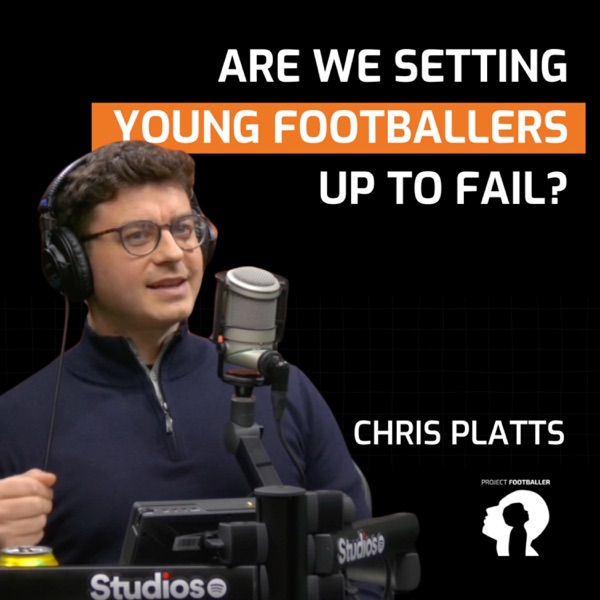
Most parents of a football-mad child have heard some version of the line: the odds of becoming a professional footballer are so small they're barely worth thinking about. Chris Platts thinks it's the wrong way to look at it altogether.
Chris is a career coach and researcher whose PhD followed the lives of more than 300 young footballers. When he joined us on Project Footballer, he broke down what the data actually says about academy football - and, just as importantly, what it doesn't. His argument is not that families should give up on the dream. It's that they should go into it with their eyes open.
Why the headline odds don't help
Chris doesn't dispute that football is hard and the chances are low. His problem with the famous tiny-percentage statistics is that one headline number hides almost everything that matters. In his view, they're usually worked out by dividing the number of top-flight players by every boy playing organised football - which assumes every child wants to turn professional.
That, Chris argued, simply isn't true. Most six, seven and eight-year-olds can't yet picture what being a professional footballer even means. They're playing because they love it. So a statistic built on the idea that they are all chasing the same dream, in his words, raises more questions than it answers.
What does "making it" actually mean?
Before any numbers, Chris starts with a question he puts to every family he works with: "what do you mean by making it? You have to be able to define it and most people can't."
Is it a one-year pro contract at 18 with no first-team appearances? A long career in League Two? Chris's point is that the answer changes. A young player might dream of the Premier League, then find themselves at a lower-league club a few years later, still with a good career ahead but different expectations. That conversation, he said, has to happen early and keep happening.
He was also clear that early selection proves very little. Signing for a club at 10 or 11 means "all you have done is shown that you are the best lad who is 11 years old at that club. No more than that." Before around 13 or 14, Chris doesn't think families need to be engaging with the data at all. The questions at that age are simpler: are they enjoying it, making friends and building confidence?
What the numbers say about the academy years
Chris's own research picks up at the under-16 scholarship stage. He found that 81% of scholars at Premier League academies were given a professional contract at 18. He recalled the proportion being lower at clubs further down the pyramid.
But he added an important caveat. Some of those contracts go to what are increasingly called "facilitator players" - young professionals signed on one or two-year deals largely so that under-21 and under-23 squads have enough numbers to train and play. A first pro contract, in other words, is the start of trying to build a career, not proof of one.
He also shared studies from outside his own work, each with its own limits. He pointed to Football Association research from 2015 which found that 0.5% of under-nines at what it called "top clubs" went on to play in a first 11 in the Football League - though Chris noted he didn't know which or how many clubs were included. A 2024 study of two Madrid clubs found that 6.1% of under-15 players reached a professional level, which Chris took to mean a professional contract rather than appearances. And an Italian study of 2,030 players who represented their country between under-15 and under-21 level from 1975 to 2001 found that 182 - 8.9% - went on to play for the senior national team, with 58 playing at a Euros or World Cup.
The first five years after a pro contract
This is the part of Chris's research that surprised us most. Of the 299 players in the cohort he analysed, 167 got some form of contract within the game. In the first five years of their careers, those players averaged five moves - two of them loans. Chris couldn't think of another industry, beyond perhaps the arts or the military, with that much upheaval straight after so many years of training.
It's why he warns against assuming that a higher-category academy is automatically the safer bet. As he put it, "the higher you start, the further you can fall." A player who drops from a Premier League club to the National League over five years may find that harder to cope with than one who drops a single division from League Two - even if both have worked just as hard. Chris wouldn't stop anyone joining a top academy - but reaching one, or landing a big contract, doesn't remove the need to plan.
It's all plan A
One of Chris's more interesting points was about the phrase "plan B". He doesn't like it. In his experience, telling a young player they need a back-up plan just leads families to say they'll deal with it if and when it happens. Instead, he frames everything as one plan: "Everybody in every career will have moments where things go wrong." The difference in football is that those moments come younger.
His approach is to build a "playbook" covering the routes a career might take - release, a loan, a move down a division - so a player can be disappointed without being blindsided. That planning, he argued, doesn't have to distract from the dream.
He also made the case for time away from the game. Scholars are under real pressure, and in Chris's view constantly watching clips of their own performances can do as much harm as good. For younger children, he believes a broader sporting background builds physical literacy, and that a weekly swimming lesson won't end anyone's chances. The hosts pushed back, arguing football rewards early time on the ball - the debate wasn't settled.
Chris also warned about survivor bias - people who made it assuming the way they were treated is why they made it. They may have got there in spite of some of it.
Our take
The "more chance of being struck by lightning" line gets repeated a lot, so it was good to hear someone with the data explain why it misleads. Not every child is playing with the same odds, and not every child is even trying to play the same game. Chris's numbers are sobering, but far more useful than a single scary percentage because they show where the hard moments tend to come.
What stood out most was his view that football shouldn't define a young person. As Chris put it, a family should keep going "until you don't want it anymore. Not that the club doesn't want it anymore." That feels like the right balance - full commitment to the dream, without letting it become the whole of who a child is.
What parents can do
Ask what "making it" means. Have the conversation with your child early, and keep coming back to it as they grow. The answer will change, and that's fine.
Don't read too much into early selection. A club signing at nine or 10 is a snapshot, not a prediction. Focus on whether they're enjoying it, making friends and growing in confidence.
Treat a pro contract as a beginning. Chris's research suggests the first few years can involve several moves and loans. Talk about that possibility before it happens.
Plan for every route, not just the best one. Thinking through release, loans and moves down the pyramid doesn't mean giving up on the dream - it means being ready for whatever comes.
Protect time away from football. Rest, other interests and time with friends help young players handle pressure. Not every spare minute needs to be spent on clips and drills.
Remind them they're more than a footballer. "If you don't get that professional contract or you don't stay in there for 10 years, that doesn't define you as a person." Make sure your child hears that from you.

.png)